
Fill Clinician Capacity With More Right-Fit Trauma Clients
MAX Brand Authority helps established trauma and EMDR group practices become easier to find, trust, and choose, so you can grow the clinicians and specialty services that need demand without compromising clinical standards.
Build a stronger flow of appropriate new-client inquiries across Google, Maps, professional referrals, and AI search, while relying less on directories and paid advertising alone.
Best for established group practices with 5-25 clinicians, at least 2 years in business, and active capacity or a priority service to grow. Select smaller group practices may qualify.
No client information is requested. No obligation. You will receive a focused review of your visibility, positioning, and intake path.
What Practice Owners Say About Working With Us
"Dale and his team did an exceptional job handling SEO (in all its various forms and components) for us at Therapy Lab. Dale is easy to work with, super knowledgeable, and generous with his time, problem-solving, and advice. I'd highly recommend working with the MAX team."
"Working with MAX Brand Authority has been a fantastic experience from start to finish. Dale is incredibly responsive and always on top of the latest SEO trends and algorithm changes. His ability to rapidly adapt strategies to match market changes is impressive."
"I can't say enough good things about Dale at MAX Brand Authority. He completely transformed my online presence, optimized my website, dialed in my SEO, and the results speak for themselves. I'm seeing significantly better reach."
You Built the Clinical Team. Demand Has Not Kept Pace.
The practice may be respected, clinically strong, and growing, yet you are still carrying the pressure of keeping every clinician and priority service appropriately utilized.
Some clinicians are full. Others still have openings.
Demand is not reaching the clinicians, locations, or specialties that need it most.
You are too dependent on referrals and directories.
Word-of-mouth is valuable, but it is difficult to forecast and does not always support the services you want to grow.
Your specialty is difficult to see online.
Your website may mention EMDR and trauma, but prospective clients cannot quickly understand why your practice is different or who it is best equipped to help.
Too many inquiries are not a fit.
Your intake team spends time sorting through insurance-only, out-of-scope, location-ineligible, or poorly matched inquiries.
Competitors are easier to find and understand.
Practices with less specialization may appear more established simply because their online presence is clearer and more visible.
Marketing keeps falling back on the owner.
Content, reviews, directories, ads, and follow-up become another operational burden rather than a coordinated growth system.
The issue is rarely a lack of clinical expertise. It is a gap between your expertise, how the market sees it, and how prospective clients move from search to intake. See how the five levers of the Authority Engine close that gap.
You Do Not Need More Random Leads. You Need Better-Aligned Demand.
The goal is not the largest possible number of inquiries. The goal is a healthier mix of appropriate prospective clients aligned with your clinicians, modalities, locations, payment model, and available capacity.
The Trauma Practice Authority Engine
One Growth System. Five Connected Levers.
Instead of purchasing disconnected marketing tactics, your practice builds an integrated system that connects how people find you, why they trust you, whether they are a fit, how they enter the practice, and where demand is needed most. Review how we build it in four steps or see results from practices we work with.
Findability
Be present wherever appropriate prospective clients and referral partners search.
- Google organic search
- Google Maps and Business Profile
- Local and specialty SEO
- AI-search visibility and entity clarity
- Reputable professional and therapy directories
- Location and specialty page architecture
Clinical Authority
Translate credentials and treatment expertise into clear, trustworthy information.
- Clinician authority profiles
- Trauma and EMDR service pages
- Condition, population, and specialty content
- FAQs and educational resources
- Evidence-informed content review
- Reviews and reputation signals
- Professional referral resources
- Strategic video and YouTube when appropriate
Client-Practice Fit
Help prospective clients understand whether the practice is appropriate before intake time is consumed.
- Clear populations and presenting concerns
- Modality and treatment-readiness education
- Location, telehealth, licensure, and payment clarity
- Clinician matching
- Scope and exclusion guidance
- Appropriate crisis and emergency boundaries
Intake Conversion
Make the path from interest to consultation clear, respectful, and easy to complete.
- Conversion-focused page structure
- Mobile-first inquiry flows
- Clear calls to action
- Secure routing and missed-inquiry follow-up
- Consultation scheduling
- Intake-team scripts and response standards
- Privacy-conscious measurement
Capacity Growth
Align marketing activity with the clinicians, services, and locations the practice actually wants to grow.
- Capacity by clinician and service
- Inquiry quality
- Consultation and start rates
- Private-pay and insurance mix
- Service-line priorities and location-level demand
- Clinician utilization
- Reporting tied to practice outcomes rather than vanity metrics
SEO, Google Business Profile, content, reviews, paid media, email, referral infrastructure, and YouTube remain part of the toolkit. They are selected to support these five levers rather than sold as separate products.
What This System Is Designed to Improve
More appropriate new-client inquiries
Attract people who better match the practice's specialties, locations, payment options, and clinician availability.
Fuller caseloads for the right clinicians
Direct demand toward associates, new hires, locations, and service lines with capacity.
Stronger private-pay and hybrid demand
Communicate the value of specialty care before the conversation is reduced to insurance participation or price.
Less dependence on a single referral source
Build multiple discovery and referral channels that work together.
Greater authority in trauma and EMDR care
Make the practice's clinical depth easier for clients, referral partners, search engines, and AI systems to understand.
A more efficient intake process
Reduce avoidable friction and help prospective clients identify fit before the intake team invests significant time.
Results depend on the market, the practice's starting point, clinician capacity, implementation, and time. We do not guarantee rankings, inquiry volume, or client starts. See real practice results and who this is built for.
Show the Evidence. Keep the Context.
We separate our own client results from third-party industry examples, and we separate engagement signals from business outcomes.
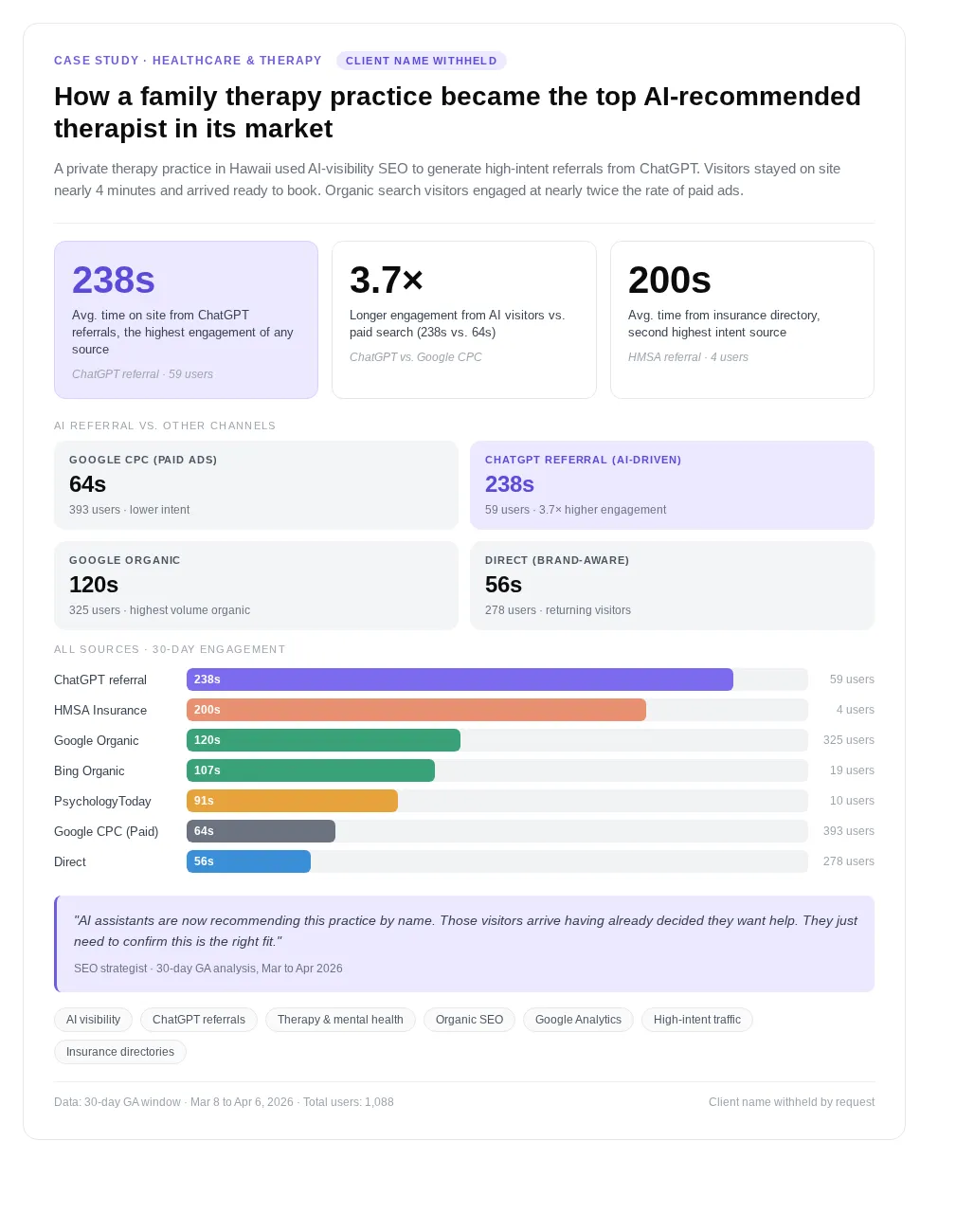
MAX Brand Authority client result
Practice type
Trauma and EMDR-informed group practice, Hawaii
Initial problem
Strong clinical reputation, but the practice depended heavily on directory and paid traffic and its specialty was hard to recognize online.
What changed
Positioning, specialty and clinician pages, local visibility, and entity clarity for AI search, supported by a clearer intake path.
Business implication
These are engagement signals, not client-acquisition results. They indicate that visitors arriving from AI search read further and stayed longer than visitors from paid search in the same period. Business-level outcomes such as qualified inquiries, consultations, and new-client starts should be reviewed with the practice before publication.
Industry example, not a MAX Brand Authority client
Local SEO and content: 87% organic traffic growth for an EMDR practice
An EMDR-specialist practice implemented a local SEO and content strategy. Within a reported 6-month period, organic search traffic grew 87% and 11 target keywords reached positions 1-5, with no paid ad spend reported.
Source: published SEO case study, soundmovesmarketing.com
Industry example, not a MAX Brand Authority client
YouTube: 13,092% view growth for a trauma counseling practice
A counseling practice focused on emotional and relationship trauma implemented a YouTube SEO strategy. Over a reported 12-month period the channel grew views by 13,092% and added 399 subscribers.
Source: published case study, Seymour Digital Media, Sep 2025
Industry examples are included to illustrate the type of change these levers can influence. They are not MAX Brand Authority results and do not predict outcomes for your practice.
Built for Established Trauma and EMDR Group Practices
This is likely a strong fit when you:
- Lead a group practice with ideally 5-25 clinicians; 2 is the minimum
- Have been operating for at least 2 years
- Offer trauma and EMDR as core or strategically important services
- Employ EMDR-trained or EMDR-certified clinicians
- Have clinician openings, uneven caseloads, a new location, or a priority service to grow
- Accept private pay, out-of-network, or a profitable hybrid model
- Want appropriate clients and consistency rather than indiscriminate volume
- Are willing to improve visibility, positioning, content, and intake over 6-12 months
This is probably not the right fit when you:
- Operate as a solo therapist with no group-practice growth plan
- Have no capacity and no specialty-growth objective
- Need guaranteed results within 30 days
- Want only a one-time tactic without addressing the larger client-acquisition path
- Are unwilling to improve intake response, clinician matching, or practice messaging
- Are choosing solely on the lowest price
Not sure whether you qualify? The assessment is designed to determine whether the practice has a solvable visibility, authority, intake, or capacity-growth gap. We will give you an honest recommendation, even when we are not the right provider.
Request My Free Practice Growth AssessmentA Practical Path From Visibility Gaps to Sustainable Growth
Practice Growth & Authority Assessment
We review Google and Maps visibility, AI-search visibility, specialty positioning, clinician and service pages, competitors, reviews and reputation, intake friction, and clinician and service-line capacity.
Create the 90-Day Growth Roadmap
We identify the highest-value gaps, the clinicians or services that need demand, the channels most likely to matter, and the metrics that will define progress.
Install the Authority and Intake Foundation
We implement the positioning, website, local-search, content, reputation, referral, conversion, and tracking components needed for the selected priorities.
Improve Authority and Practice-Level Outcomes Over Time
We publish, optimize, measure, and redirect effort based on qualified inquiries, consultations, client starts, clinician utilization, and strategic service-line goals.
A privacy-conscious approach to marketing measurement
Our tracking architecture is designed to minimize the collection and transmission of protected health information. The assessment form on this page does not request client names, diagnoses, treatment details, or any other client information, and we do not connect to your EHR.
We collect only the business contact and practice details you submit, plus de-identified marketing performance data. The exact configuration for your practice depends on your systems and should be reviewed with your legal, compliance, and technology advisors. Nothing here is legal advice or a blanket compliance guarantee.
Questions Practice Owners Ask
Find Out What Is Preventing the Right Clients From Finding and Choosing Your Practice
Request a free Practice Growth & Authority Assessment. We will review how your practice appears across Google, Maps, AI search, specialty content, and the intake path, then identify the highest-priority gaps affecting visibility, client fit, and clinician capacity.
Best fit: established trauma and EMDR group practices with 2 or more clinicians, at least 2 years in business, and clinician capacity or a priority service to grow. Please do not enter client names, diagnoses, treatment details, or other protected health information.
Step 1 of 2 · Tell us about your practice